

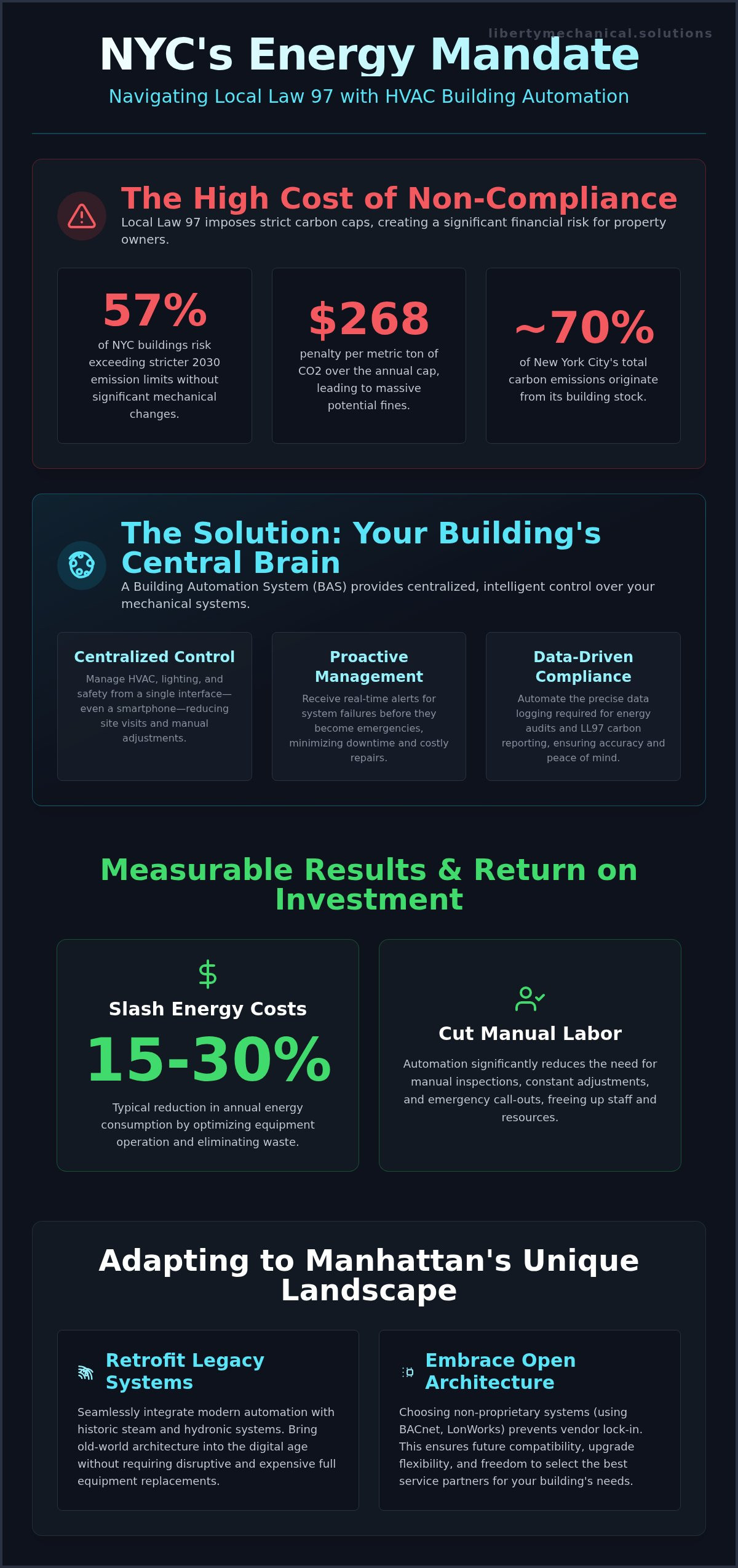
Approximately 57% of New York City buildings are projected to exceed the stricter 2030-2034 emissions limits if they don't make significant mechanical changes. For property owners, the challenge isn't just about keeping tenants comfortable; it is about avoiding the $268 per metric ton penalty for exceeding carbon caps under Local Law 97. Implementing HVAC building automation Manhattan allows you to bridge the gap between aging legacy systems and the digital precision required by today's environmental regulations.
Managing a Manhattan property often feels like a constant battle against rising utility bills and the stress of potential non-compliance fines. It's frustrating to handle tenant complaints about uneven heating while knowing your energy usage is higher than it should be. At Liberty Mechanical Solutions, we understand these challenges. This guide will show you how modern building automation can slash your energy costs and simplify your daily operations, helping you gain centralized control over your mechanical systems to improve building value and ensure long-term compliance with city standards.
Key Takeaways
- Learn how Building Automation Systems act as the central brain to manage Manhattan's extreme seasonal temperature shifts.
- Understand how modernizing your controls helps you avoid heavy fines from NYC Local Law 97 carbon emission limits starting in 2026.
- Discover how HVAC building automation Manhattan can be retrofitted into historic steam and hydronic systems to bring old-world architecture into the digital age.
- See how automated systems typically reduce energy costs by 15-30% while cutting down on manual labor and maintenance inspections.
- Find out why choosing a brand-neutral partner and securing 24/7 support ensures your building stays efficient without getting locked into a single vendor.
Understanding HVAC Building Automation in the Manhattan Landscape
Think of a building's mechanical systems as its heart and lungs. Without a brain to coordinate them, energy is wasted and components wear out prematurely. Building automation (BAS) serves as that brain, providing a centralized network of hardware and software that controls HVAC, lighting, and safety systems from a single interface. In the dense environment of New York City, HVAC building automation Manhattan is no longer a luxury reserved for new developments; it's a necessity for any property owner looking to survive the city's volatile energy market and strict regulatory climate.
Manhattan experiences extreme seasonal shifts that put immense strain on mechanical equipment. We swing from humid, 90-degree July afternoons to sub-zero January nights where steam pipes must work overtime. Automation allows a building to anticipate these changes rather than reacting to them after tenants start calling to complain. It creates a bridge between legacy systems, like century-old steam boilers, and modern digital precision. For NYC owners, choosing an "open architecture" system is vital. Unlike proprietary systems that lock you into one manufacturer, open systems allow different brands of equipment to communicate, giving you the freedom to choose the best service partners for your specific needs.
The Core Components of a Manhattan BAS
Every effective system relies on high-quality sensors and controllers. These are the eyes and ears of your mechanical room, monitoring everything from pipe temperature to ambient humidity. Modern systems feature a user interface that allows you to manage an East Village walk-up or a Midtown high-rise directly from your smartphone. To ensure your investment lasts, we focus on communication protocols like BACnet and LonWorks. These industry standards ensure your hardware remains compatible with future upgrades, preventing your system from becoming obsolete in a few years.
Why Manhattan Property Managers are Switching to Automation
The move toward automation is driven by a need for efficiency and risk management. Property managers can now oversee multiple units or entire city blocks from one dashboard, reducing the need for constant site visits. Real-time alerts are a critical safety net; they notify you of a pressure drop or a burner failure before it turns into a 2 a.m. emergency boiler repair. Additionally, automation provides the precise data logging required for mandatory NYC energy audits. With Local Law 97 penalties reaching $268 per metric ton of excess carbon, having accurate, automated records is the only way to prove compliance and avoid massive fines during the June 2026 reporting deadline.
The Impact of NYC Local Law 97 on HVAC Automation
NYC Local Law 97 is no longer a distant regulatory threat. Starting in 2024, the first compliance period began, but the stakes get much higher as we approach the 2026 reporting deadlines. Building owners face a penalty of $268 for every metric ton of CO2 equivalent that exceeds their annual cap. Since nearly 70% of New York City's carbon emissions come from buildings, your mechanical systems are the primary targets for reduction. Traditional manual adjustments simply lack the precision required to hit these strict environmental targets. Implementing HVAC building automation Manhattan provides a data-driven way to lower emissions without the need for a total building reconstruction.
An HVAC retrofit for energy savings through automation is often the most logical path to compliance. While a full equipment replacement can be disruptive and expensive, a BAS install optimizes your existing infrastructure. It ensures boilers aren't firing unnecessarily and pumps aren't running at full speed during low-demand hours. For most Manhattan owners, the calculation is straightforward: the investment in automation pays for itself by avoiding cumulative fines that could otherwise reach six or seven figures over the next decade. Precision control isn't just about being "green"; it's about protecting your building's bottom line.
Carbon Tracking and Reporting
The annual deadline for submitting carbon emissions reports is May 1st, though for 2026, the Department of Buildings will accept reports until June 30th. Manually calculating these figures is difficult and leaves room for error. A BAS simplifies this by logging every therm of gas and kilowatt of electricity used by your mechanical plant. It identifies "energy leaks" in commercial spaces, such as heating an empty office floor at midnight, before those leaks turn into expensive penalties. In residential brownstones, smart thermostats integrated into a central system provide similar granular control, allowing managers to balance comfort with strict emission caps.
Incentives for Energy Upgrades
The city and local utilities offer financial support to help you upgrade. There are significant NYC tax abatements available for installing high-efficiency controls that meet specific performance standards. Additionally, utility providers like Con Edison offer rebates for automated demand-response systems that reduce strain on the power grid during peak summer heat. These incentives can significantly offset the initial cost of Building Automation Systems. Our team helps you navigate the documentation required for these programs, ensuring you get the maximum financial benefit while securing your building's future.
Retrofitting Manhattan: Automation for Legacy Steam and Hydronic Systems
Manhattan's architectural landscape is defined by its history, which means most of the city's heating infrastructure relies on century-old steam and hydronic technology. When people discuss HVAC building automation Manhattan, they often picture sleek glass towers, but the real impact of this technology is found in the basements of historic pre-war buildings. Modernizing a 100-year-old system isn't just possible; it's the most effective way to improve performance without the massive cost of a complete teardown. Automation acts as a digital layer that brings precision to "old iron" equipment that was originally designed for a different era.
Common issues like banging radiators and uneven heat aren't just charming quirks of an old building. They're clear signs of mechanical inefficiency. Sensors installed throughout the building provide the data needed to resolve these problems at the source. By monitoring pressure and temperature in real time, the system can adjust boiler firing rates to match actual demand. We also integrate variable frequency drives (VFDs) onto legacy pump motors. These drives allow old motors to adjust their speed based on current needs rather than running at full throttle 24/7, which significantly reduces electricity consumption.
Smart Steam Management
Zone control for steam systems finally ends the "open window in winter" syndrome, where tenants are forced to vent excess heat because their apartments are sweltering. Automation also handles critical maintenance tasks like boiler blowdown and water treatment monitoring, ensuring the system stays clean and efficient. Perhaps the most important benefit is steam trap monitoring. In a typical Manhattan basement, a single failed steam trap can waste thousands of dollars in energy every year. Automated sensors catch these failures immediately, allowing for targeted repairs before the energy bill spikes.
Hydronic Balancing via Automation
Precision temperature control for hot water radiant systems ensures that every floor receives the exact amount of heat required, regardless of its distance from the boiler room. Automated load balancing reduces the physical strain on your pumps, which prevents premature mechanical failure and extends the life of your equipment. At Liberty Mechanical Solutions, we take pride in our ability to bridge the gap between "old iron" and "new silicon." We ensure your historic infrastructure performs with the reliability and efficiency of a modern build, protecting both your tenants' comfort and your building's long-term value.
Calculating ROI: Energy Savings and Building Value
Investing in HVAC building automation Manhattan provides a clear financial return that goes beyond simple energy conservation. Commercial buildings typically see a 15% to 30% reduction in energy costs within the first year of installation. These savings occur because the system eliminates the "human error" of leaving units running in empty spaces or fighting against outdoor temperature shifts. By optimizing every cycle of your boilers and chillers, you aren't just saving on fuel; you're also significantly extending the lifespan of your most expensive mechanical assets. Reducing unnecessary run-times means fewer overhauls and a longer gap between major capital replacements.
Property value in the city is increasingly tied to a building's technological maturity. Achieving "Smart Building" status makes a property more attractive to premium Manhattan tenants who prioritize modern amenities and environmental responsibility. A building that is easy to manage and cheap to operate naturally commands higher lease rates and a better position in the market. When it comes time for an appraisal or refinancing, the documented efficiency of an automated system serves as a tangible asset that justifies a higher valuation.
Operational Efficiency Gains
Automation shifts your maintenance strategy from reactive to predictive. Instead of waiting for a tenant to report a lack of heat, the system identifies a failing bearing or a drop in pump pressure before the entire motor fails. This proactive approach drastically reduces the need for manual inspections of mechanical rooms, saving on labor costs and avoiding the chaos of emergency repairs. Technicians can often perform remote troubleshooting to diagnose issues without a site visit, which speeds up resolution times and keeps your building running smoothly. Consistent comfort levels also lead to higher tenant satisfaction, which directly decreases expensive turnover and vacancy periods.
The Long-Term Financial Picture
Most commercial HVAC automation projects in the city have a payback period of 2 to 7 years, though this can be much shorter when factoring in avoided Local Law 97 fines. A well-tuned BAS can reduce peak demand charges by 20%, which is a significant portion of a Manhattan utility bill. These demand charges are often the most expensive part of your energy costs during the summer months. By spreading the electrical load and avoiding spikes in usage, you protect your budget from unpredictable fluctuations. If you are ready to see how these savings apply to your specific property, you can consult with our building automation specialists to start your ROI calculation.
Choosing an HVAC Automation Partner in Manhattan
Selecting a partner for HVAC building automation Manhattan is a long-term commitment that affects your building's operational health for decades. This isn't just a software installation; it's a mechanical upgrade that requires a deep understanding of how digital controls interact with physical hardware. Brand-neutrality is a critical factor to consider during your search. Many national firms push proprietary systems that lead to "vendor lock-in," leaving you unable to shop for competitive service rates or integrate new technology later. Choosing an open-protocol system ensures you maintain control over your own mechanical room.
A reliable contractor must demonstrate a thorough understanding of NYC-specific mechanical codes and environmental laws. Manhattan's density and aging infrastructure present challenges that a technician from outside the city might not anticipate. Your partner should provide 24/7 emergency support to act as a safety net for your automated systems. If a sensor glitches during a deep freeze, you need a local expert who can be on-site within hours. At Liberty Mechanical Solutions, we approach HVAC building automation Manhattan with a focus on results. We avoid confusing jargon and provide straightforward assessments of what your building actually needs to stay compliant and efficient.
The Liberty Mechanical Advantage
We maintain a strong local presence in both Manhattan and Westchester, which allows for rapid response times when issues arise. Our team offers a rare combination of expertise in traditional plumbing, high-pressure steam, and modern digital automation. This cross-disciplinary knowledge is vital because an automation system is only as good as the pipes and valves it controls. We prioritize transparent pricing and professional communication. You will always know exactly what work is being performed and why it matters for your building's longevity. We take pride in being the knowledgeable guide that helps you manage complex mechanical challenges with calm competence.
Next Steps for Your Property
The path to a more efficient building starts with a comprehensive mechanical system audit. This process identifies specific automation opportunities where you can see the fastest return on investment. You don't have to automate every floor or every unit at once. We often recommend a phased implementation, starting with the central boiler plant or the main cooling towers to secure immediate energy savings. This allows you to scale the system as your budget permits while still making progress toward Local Law 97 compliance. If you are ready to modernize your building's controls, you can Schedule a Building Automation Consultation with Liberty Mechanical Solutions to discuss a customized plan for your property.
Secure Your Building's Future with Smart Controls
Manhattan property owners no longer have to choose between historic charm and modern efficiency. By implementing HVAC building automation Manhattan, you can bridge the gap between legacy steam systems and the rigorous carbon limits of Local Law 97. These systems don't just reduce energy costs by up to 30% within the first year; they also provide the precise data logging required to avoid massive non-compliance fines. Automation transforms your mechanical room from a source of stress into a predictable, manageable asset that adds tangible value to your property.
Our team serves as your local, trusted Manhattan contractor with deep specialization in NYC steam and hydronic systems. We understand the nuances of the city's unique architectural landscape and provide 24/7 emergency mechanical support to act as your safety net. If you're ready to lower your operational costs and improve building value, Get a Straightforward Quote on HVAC Automation for Your Manhattan Building. Investing in these smart controls today ensures your property remains competitive, comfortable, and compliant well into the future.
Frequently Asked Questions
What is the difference between a BMS and an HVAC control system?
A Building Management System (BMS) is a broad platform that manages all building functions, including lighting, security, and fire safety. An HVAC control system is a specialized subset of that platform focused specifically on your heating and cooling equipment. Implementing HVAC building automation Manhattan allows you to integrate these mechanical controls into a centralized dashboard for better operational oversight.
Can building automation be installed in a pre-war Manhattan building?
You can absolutely install automation in historic pre-war structures. We focus on retrofitting aging steam and hydronic systems with digital sensors and variable frequency drives. This process brings modern precision to "old iron" infrastructure without requiring a full mechanical teardown. It is the most practical way to modernize Manhattan's historic architectural assets while maintaining their original character.
How much can I realistically save on energy bills with HVAC automation?
Property owners typically see a 15% to 30% reduction in energy costs within the first year of operation. These savings come from eliminating unnecessary equipment run-times and optimizing boiler firing rates based on real-time outdoor temperatures. By reducing peak demand charges during high-use months, the system provides a consistent return on investment through significantly lower monthly utility bills.
Does HVAC automation help with NYC Local Law 97 compliance?
Automation is a primary tool for meeting the strict requirements of Local Law 97. It provides the granular control needed to slash carbon emissions and generates the automated energy usage reports required by the Department of Buildings. With the June 2026 reporting deadline approaching, having these digital records is essential for avoiding the $268 per metric ton penalty for excess emissions.
What happens to my HVAC system if the automation software crashes?
Your mechanical equipment is designed with built-in fail-safe protocols. If the software ever crashes, the system automatically reverts to local manual control or a pre-determined safety state to ensure your building stays heated or cooled. Our 24/7 emergency support team is always available to restore full automated functionality quickly if a software or communication glitch occurs.
Is wireless building automation reliable enough for large Manhattan buildings?
Wireless technology is now highly reliable for dense urban environments. We utilize industrial-grade mesh networks that are specifically designed to penetrate the thick masonry and steel common in Manhattan's older buildings. Wireless sensors are often the most cost-effective way to implement HVAC building automation Manhattan because they eliminate the need for invasive and expensive wiring projects.
How long does a typical BAS installation take for a commercial property?
A typical installation for a mid-sized commercial property usually ranges from three to six months. The exact timeline depends on the complexity of your existing mechanical systems and the number of zones being automated. We often recommend a phased approach so you can begin seeing energy savings in your main mechanical room while we finalize the rest of the building.

